
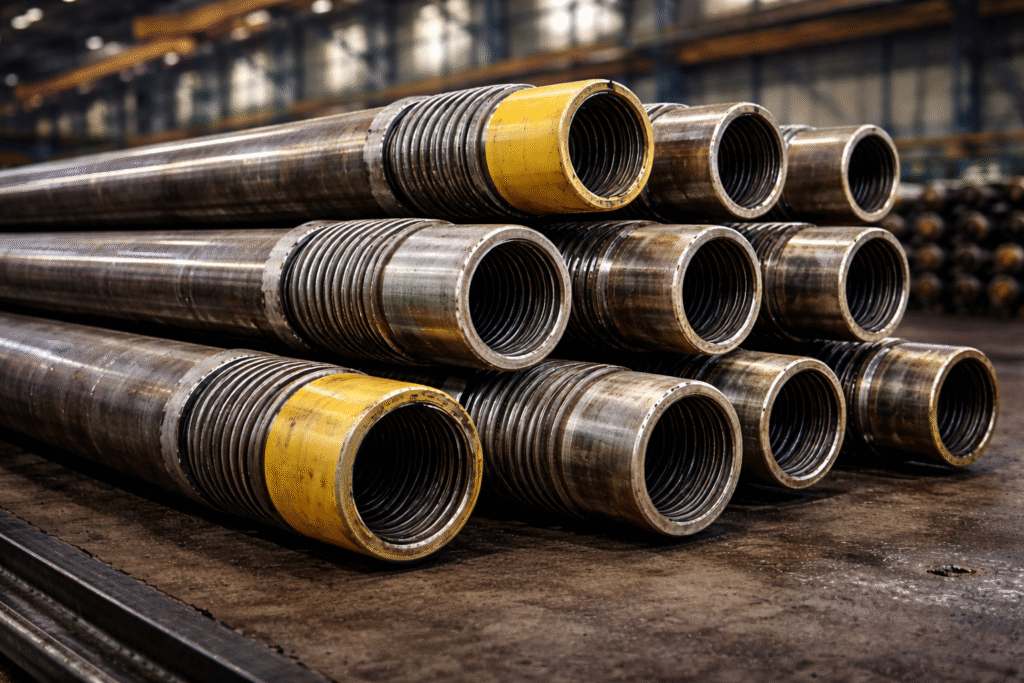
All pipes mentioned in this article are sold by PANDAPIPE.
Choosing the right drilling pipe depends on load conditions, drilling trajectory, inspection requirements, and service life—not simply on grade or price. Proper selection reduces failure risk and long-term operating cost.
In drilling operations, drilling pipe is not a consumable item—it is a structural component that directly affects operational safety, drilling efficiency, and total project cost. Selecting an unsuitable drilling pipe rarely causes immediate failure, but over time it often results in fatigue damage, unplanned downtime, and premature replacement.
This guide explains how drilling pipe is evaluated and selected in real industrial projects. The focus is on functional requirements, specifications, standards, failure risks, and procurement considerations—written for engineers and buyers who need decision-ready information, not simplified definitions.
What Is Drilling Pipe and What Does It Do
Drilling pipe is a hollow steel tube that forms the main body of the drill string. Its function goes well beyond connecting downhole tools.
During drilling operations, drilling pipe is responsible for:
-
Transmitting rotational torque from the rig to the drill bit
-
Carrying axial load, including the weight of the entire drill string
-
Providing an internal flow path for drilling fluid to cool the bit and transport cuttings
Because drilling pipe is continuously rotated, bent, and pressurized, it operates under cyclic stress conditions. This makes material quality, dimensional control, and inspection discipline critical to long-term performance.
Drilling Pipe vs. Other Oilfield Tubulars
In procurement, drilling pipe is often confused with other tubular products, which leads to incorrect specifications.
-
Drilling pipe is a temporary, reusable component designed to rotate and transmit torque.
-
Casing is a permanent structural element used to stabilize the wellbore.
-
Tubing is installed after drilling to transport produced fluids.
Each product serves a different function and is designed for different loading conditions. Substituting one for another is not technically acceptable and often violates project specifications.
Key Technical Specifications Engineers Evaluate
While outside diameter and wall thickness are basic parameters, experienced engineers usually look beyond these numbers to understand how the pipe will behave under real drilling conditions.
Outside Diameter and Wall Thickness
These parameters directly affect torsional strength, collapse resistance, and fatigue life. Consistent wall thickness is particularly important in deeper wells and directional drilling, where localized stress concentrations can accelerate fatigue damage.
Section Modulus and Polar Moment of Inertia
These properties describe the pipe’s resistance to bending and torsional loads. In extended-reach drilling, insufficient stiffness often becomes a limiting factor long before tensile strength is reached.
Tool Joint Design
Tool joints are typically the highest-stress locations in the drill string. Their material grade, heat treatment quality, and welding consistency play a major role in connection life. Many fatigue-related failures originate at or near the tool joint rather than in the pipe body itself.
API Length Ranges and Operational Efficiency
Standardized pipe length ranges help improve rig floor efficiency and reduce handling-related issues.
-
Range 1 (R1): 18–22 ft
Common in shallow wells and certain mining applications. -
Range 2 (R2): 27–30 ft
The industry standard for most onshore and offshore oil and gas drilling projects. -
Range 3 (R3): 38–45 ft
Used in deep-water or high-efficiency drilling where reducing the number of connections is a priority.
Inconsistent pipe length may appear minor on paper, but on the rig floor it can slow tripping operations and increase connection-related fatigue over time.
Drilling Pipe Grades and Their Practical Meaning
Drilling pipe grades define the mechanical strength of both the pipe body and tool joints. Common grades include E75, X95, G105, and S135.
Grade selection depends on:
-
Maximum drilling depth and hook load
-
Required torque transmission
-
Fatigue risk in directional or extended-reach wells
Higher-grade pipe provides greater strength, but over-specifying grade often increases cost without extending service life.

Standards and Compliance Requirements
Most drilling pipe used in oil and gas projects is manufactured in accordance with API Spec 5DP.
This standard defines requirements for:
-
Chemical composition
-
Mechanical properties
-
Heat treatment
-
Dimensional tolerances
-
Inspection and testing procedures
Compliance ensures consistency, traceability, and predictable performance under defined operating conditions.
Manufacturing Process and Quality Control
Drilling pipe manufacturing typically includes:
-
Pipe body forming and heat treatment
-
Tool joint machining
-
Welding of tool joints to the pipe body
-
Post-weld heat treatment
-
Final inspection and testing
Each step influences fatigue resistance and service life. Weak process control at any stage can lead to early failure, even if the material nominally meets the standard.
Inspection and Testing: Why It Matters
Because drilling pipe operates under repeated stress cycles, inspection is not optional.
Common inspection methods include:
-
Ultrasonic testing (UT) for internal defects
-
Magnetic particle inspection (MPI) for surface cracks
-
Dimensional verification
-
Mechanical testing of representative samples
These inspections help identify defects before they propagate into critical failures during drilling operations, where downtime costs can escalate quickly.
Typical Applications of Drilling Pipe
Drilling pipe is used across multiple industries:
-
Oil and gas drilling
-
Water well drilling
-
Geothermal projects
-
Mining and exploration
Although operating environments differ, the performance requirement remains the same: stable mechanical behavior under repeated loading.
Common Failure Modes in Drilling Pipe
Understanding failure mechanisms helps prevent costly downtime.
The most common failure modes include:
-
Fatigue cracking, often initiated at tool joints
-
Washout, caused by internal erosion from drilling fluids
-
Connection failure, due to improper make-up or material mismatch
-
Corrosion, particularly in aggressive drilling environments
Most failures result from a combination of material choice, operating conditions, and inspection quality—not a single factor.
How to Choose the Right Drilling Pipe for Your Project
Before finalizing procurement, it is important to evaluate the overall drilling conditions:
-
Maximum depth and load conditions
-
Drilling trajectory (vertical or directional)
-
Expected service life and reuse cycles
-
Required inspection and acceptance criteria
Clarifying these points early helps avoid both over-specification and under-performance.
Why Supplier Capability Matters
In drilling pipe supply, consistency is as important as nominal strength.
A reliable supplier provides:
-
Stable production batches
-
Full material traceability
-
Documented inspection records
-
Technical support during selection and use
This reduces uncertainty and improves field performance predictability.
Final Perspective
Selecting drilling pipe is not about choosing the strongest or most expensive product. It is about selecting a solution that matches real operating conditions, complies with applicable standards, and delivers predictable performance over its intended service life.
When these factors align, drilling pipe becomes a reliable asset rather than a hidden project risk.
PANDAPIPE’s technical team can quickly help you find the right drill pipe. Contact us right away!
FAQs
1. What is the difference between drilling pipe and casing?
Drilling pipe is reusable and rotates; casing is permanent and structural.
2. How do I choose drilling pipe grade?
Grade selection depends on depth, load, torque, and fatigue risk.
3. Is higher-grade drilling pipe always better?
Not necessarily. Over-specification increases cost without improving service life.


