
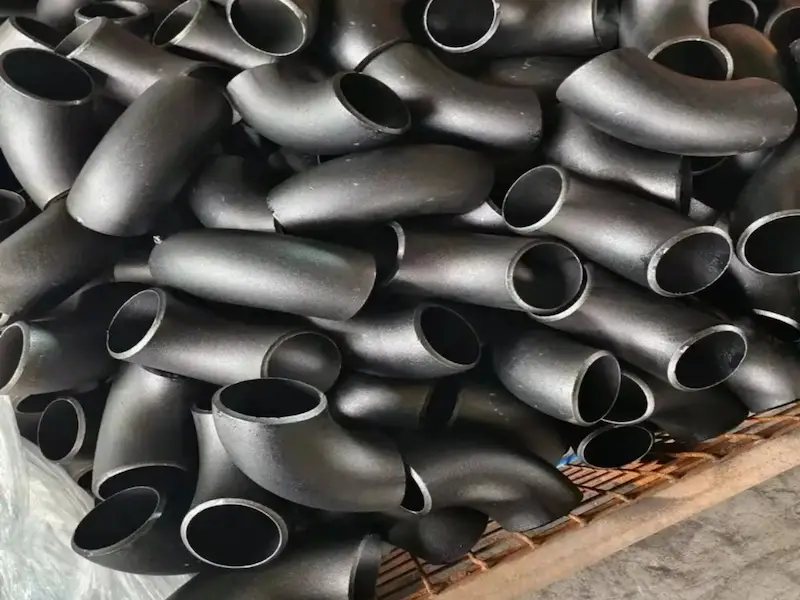
All pipes mentioned in this article are sold by our company.
Learn how to measure a pipe fitting correctly using real engineering methods. This guide helps you avoid size mismatch, identify thread types, and confirm dimensions before ordering.
Introduction
Many piping failures do not start with material defects. They start with wrong measurements.
A fitting that looks correct can still fail during installation. Threads do not seal. Lines do not align. Pressure ratings do not match.
If you work in sourcing, inspection, or installation, you have likely seen this.
This guide explains how to measure a pipe fitting using practical methods and standard references. The goal is simple: reduce mismatch risk before ordering or installation.
Quick Summary
If you only have one minute:
- Always measure OD and verify against NPS charts
- Confirm thread type (NPT vs BSP) before ordering
- Check center-to-end dimensions for elbows and tees
- Never assume nominal size equals actual measurement
What Does Measuring a Pipe Fitting Really Mean?
Measuring a pipe fitting is not only about diameter.
It is about confirming whether the fitting will:
- Connect correctly
- Fit within the layout
- Meet the required standard
For pipes, measurement usually focuses on OD, wall thickness, and length.
For fittings, the focus shifts to:
- End connection size
- Thread type (NPT / BSP)
- Center-to-end dimensions
- Schedule or pressure class
Key conclusion: Measured diameter is not equal to nominal pipe size (NPS).
This is the most common cause of procurement errors.

When Do You Need to Measure a Pipe Fitting?
Installation or Replacement
On-site conditions are rarely ideal.
Drawings may be outdated or missing. You need to match existing fittings without trial and error.
Before Placing an Order
Most mistakes happen at this stage.
A “2-inch fitting” may refer to:
- Nominal size (NPS)
- Actual OD
- Different thread standards
Without verification, mismatch risk is high.
Incoming Inspection and QA
In EPC projects, dimensional verification is part of acceptance.
According to ASME B16 standards, dimensional tolerances must be checked to ensure interchangeability and safety.
Step-by-Step: How to Measure a Pipe Fitting
Step 1 – Identify the Fitting Type
Start with geometry:
- Elbow
- Tee
- Coupling
- Reducer
Different fittings require different measurement points.
Example:
- Elbows → center-to-end
- Couplings → bore and length
Step 2 – Measure Diameter Correctly
Use a vernier caliper for accuracy.
For threaded fittings:
- Measure the outside diameter of the thread
- Avoid measuring only thread peaks
For socket weld or butt weld fittings:
- Measure pipe OD or internal bore
Important: Measured OD ≠ NPS
Always convert using a standard pipe size chart.
Step 3 – Identify Thread Type and Pitch
Thread mismatch often leads to leakage or rework.
The two main standards:
- NPT (ASME B1.20.1)
- BSP (ISO 7 / ISO 228)
Key differences:
- Thread angle (60° vs 55°)
- Taper vs parallel
- Pitch
Use a thread gauge if available.
Step 4 – Measure Center-to-End Dimensions
Critical for layout and installation.
For elbows:
- Measure from centerline to end face
For tees:
- Measure run and branch center distances
Engineering note: Incorrect center distance causes alignment failure even when diameter is correct.
Step 5 – Confirm Wall Thickness or Pressure Class
Check:
- Schedule (Sch 40 / Sch 80 / Sch 160)
- Pressure class (3000#, 6000#)
Two fittings may look identical externally but perform differently under pressure.
Tools Recommended for Accurate Measurement
Use reliable tools only:
- Vernier caliper (preferred)
- Thread gauge
- Steel ruler or tape (backup only)
Avoid estimation. Dimensional error leads to system risk.
1. How do I measure a pipe fitting size correctly?
Measure the OD with a caliper and match it with an NPS reference chart.
2. Is nominal size the same as actual size?
No. Nominal size is a reference value, not the actual measured diameter.
3. How do I identify NPT vs BSP threads?
Check thread angle, taper, and pitch. Use a thread gauge or compare with standards.
4. What is the most accurate measurement tool?
A vernier caliper provides the best accuracy.
5. Why is center-to-end measurement important?
It ensures correct alignment during installation.
6. Can two fittings with same size behave differently?
Yes. Different schedules or pressure classes affect performance.
7. What standards apply to pipe fittings?
Common standards include ASME B16.9, B16.11, and ASTM material specifications.
8. What happens if I choose the wrong fitting?
It may lead to leakage, system failure, or costly rework.


