
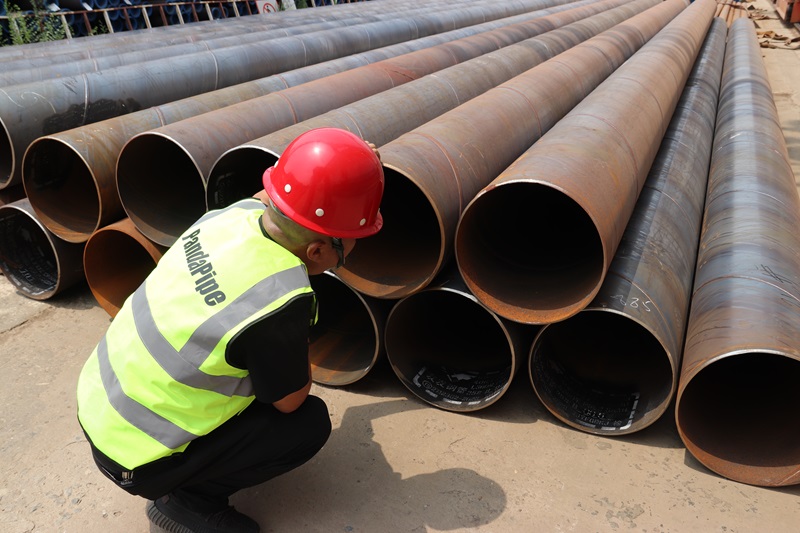
All pipes mentioned in this article are sold by PANDAPIPE.
How thick is schedule 40 pipe?
This is one of the most common technical questions in piping projects.
The answer is straightforward but often misunderstood: Schedule 40 pipe thickness depends on the nominal pipe size (NPS). It is not one fixed wall value.
Schedule 40 is defined by internationally recognized standards and is widely used because it balances strength, weight, weldability, and cost. Below, you’ll find the exact wall thickness values, the governing standards, engineering considerations, and what procurement teams should confirm before placing an order.
Quick Summary – How Thick Is Schedule 40 Pipe?
There is no single thickness for Schedule 40.
Wall thickness increases as pipe diameter increases to maintain hoop stress resistance under internal pressure.
For example:
-
1″ Schedule 40 thickness = 0.133 inch (3.38 mm)
-
2″ Schedule 40 thickness = 0.154 inch (3.91 mm)
-
6″ Schedule 40 thickness = 0.280 inch (7.11 mm)
-
12″ Schedule 40 thickness = 0.406 inch (10.31 mm)
The outside diameter remains constant for a given NPS. Only the wall thickness changes between schedules.
What Does Schedule 40 Actually Mean?
Many buyers assume Schedule 40 defines pressure rating. It does not.
Schedule Refers to Wall Thickness, Not Pressure
In the NPS system:
-
Outside Diameter (OD) is fixed.
-
Wall thickness varies by schedule number.
-
Inside Diameter (ID) decreases as wall thickness increases.
For example, a 2″ Schedule 40 pipe and a 2″ Schedule 80 pipe have the same OD. However, Schedule 80 has a thicker wall and smaller ID.
This standardization ensures compatibility with flanges, fittings, valves, and welded connections.
Which Standards Define Schedule 40 Dimensions?
Schedule 40 dimensions are governed by:
-
ASME B36.10M – Welded and seamless wrought steel pipe
-
ASME B36.19M – Stainless steel pipe (Sch 40S)
These standards define OD and wall thickness to ensure global interchangeability.
If your specification references ASTM A53, ASTM A106, or API 5L, the dimensional schedule still follows ASME B36.10M.
Below are commonly requested sizes for carbon steel pipe under ASME B36.10M:
| NPS | OD (inch) | Wall Thickness (inch) | Wall Thickness (mm) |
|---|---|---|---|
| 1/2″ | 0.840 | 0.109 | 2.77 |
| 1″ | 1.315 | 0.133 | 3.38 |
| 2″ | 2.375 | 0.154 | 3.91 |
| 3″ | 3.500 | 0.216 | 5.49 |
| 4″ | 4.500 | 0.237 | 6.02 |
| 6″ | 6.625 | 0.280 | 7.11 |
| 8″ | 8.625 | 0.322 | 8.18 |
| 12″ | 12.750 | 0.406 | 10.31 |
Thickness increases with diameter because larger pipes experience higher circumferential (hoop) stress under internal pressure.
Why Engineers Frequently Select Schedule 40
Schedule 40 is often referred to as “Standard Weight (STD)” for sizes up to NPS 10.
It is widely selected because it offers:
1. Balanced Strength-to-Weight Ratio
For water, compressed air, fire systems, and general industrial service, Schedule 40 typically provides adequate safety margin without unnecessary structural load.
2. Cost Efficiency
Schedule 40 is mass-produced globally. Higher production volume generally means shorter lead times and stable pricing compared to heavier schedules.
3. Practical Weldability
The wall thickness allows standard welding procedures without excessive bevel preparation or multi-pass welding required by heavier schedules.
Typical Applications of Schedule 40 Pipe
Schedule 40 is commonly used in:
-
Municipal water distribution
-
HVAC chilled water lines
-
Fire sprinkler systems
-
Compressed air systems
-
General industrial utilities
-
Structural supports
-
Low-to-medium pressure oil and gas transport
For high-pressure steam, high-temperature service, or corrosive chemical systems, engineers often select Schedule 80 or higher to allow additional corrosion margin.
Critical Technical Clarification: Schedule ≠ Pressure Rating
This is a frequent source of procurement errors.
Allowable working pressure depends on:
-
Material grade (e.g., ASTM A53, ASTM A106, API 5L)
-
Wall thickness
-
Operating temperature
-
Corrosion allowance
-
Design safety factor
For example:
A Schedule 40 pipe manufactured under ASTM A53 Grade B does not have the same pressure capacity as a Schedule 40 pipe under API 5L X52.
Schedule defines thickness.
Material grade defines strength.
Pressure design typically follows formulas such as Barlow’s formula, using allowable stress values defined in ASME design codes.
Manufacturing Tolerance and Inspection
According to ASTM standards, wall thickness tolerance generally permits up to 12.5% under the nominal wall thickness.
This means actual thickness may be slightly lower than the nominal value.
For critical projects, it is recommended to specify:
-
Minimum wall thickness requirement
-
Hydrostatic testing
-
Third-party inspection
-
Mill Test Certificate (EN 10204 3.1)
Clear technical specifications reduce compliance disputes and project delays.
Schedule 40 vs Schedule 80 – When to Upgrade
| Factor | Schedule 40 | Schedule 80 |
|---|---|---|
| Wall Thickness | Medium | Thick |
| Pressure Capacity | Moderate | Higher |
| Weight | Lighter | Heavier |
| Welding Effort | Standard | Increased |
| Cost | Lower | Higher |
As a general engineering guideline:
If design pressure is moderate and corrosion is controlled, Schedule 40 is usually sufficient.
If operating pressure, temperature, or corrosion allowance increases, engineers often choose Schedule 80 for additional safety margin.
How to Select the Correct Schedule Before Sending an RFQ
Before requesting a quotation, confirm the following:
1. Design Pressure and Temperature
Start with engineering calculation, not price comparison.
2. Material Grade
Common grades include ASTM A53, ASTM A106, and API 5L. Each has different mechanical properties.
3. Pipe Manufacturing Type
Seamless (SMLS) for higher pressure or critical systems.
ERW for cost-efficient general applications.
4. End Preparation
Plain End (PE), Beveled End (BE), or Threaded & Coupled (T&C).
5. Surface Treatment
Black lacquered, galvanized, FBE coating, or 3LPE coating.
Clear RFQ details significantly reduce delivery errors and rework costs.
FAQs
1. How thick is 2 inch Schedule 40 pipe?
The wall thickness is 0.154 inch (3.91 mm).
2. Is Schedule 40 the same as Standard Weight (STD)?
For sizes up to NPS 10, Schedule 40 is generally equivalent to STD. Larger sizes may differ.
3. Can Schedule 40 handle high-pressure gas?
Only if engineering calculations confirm allowable stress meets safety requirements.
4. Does Schedule 40 mean high pressure?
No. It is a dimensional classification, not a pressure rating.
5. Is Schedule 40 stronger than Schedule 10?
Yes, because it has a thicker wall.
6. What material is Schedule 40 pipe made from?
Common materials include carbon steel (ASTM A53, A106) and stainless steel (Sch 40S).
7. Does Schedule 40 affect welding procedures?
Yes. Thicker walls require more welding input and inspection.
8. How do I verify compliance?
Request a Mill Test Certificate and confirm conformity to ASME and ASTM standards.
How Thick Is Schedule 40 Pipe – Need Verified Supply?
If you are specifying how thick is schedule 40 pipe for a tender or industrial project, we can assist with technical verification and compliant supply.
At PANDAPIPE, we supply:
-
Schedule 40 carbon steel and stainless steel pipes
-
Seamless and ERW options
-
Full MTC traceability
-
Export-compliant packaging
-
Custom cutting and coating services
Our team supports project-based RFQs with dimensional confirmation and compliance review.
Contact us today to receive a detailed quotation and technical support for your Schedule 40 pipe requirements.


