
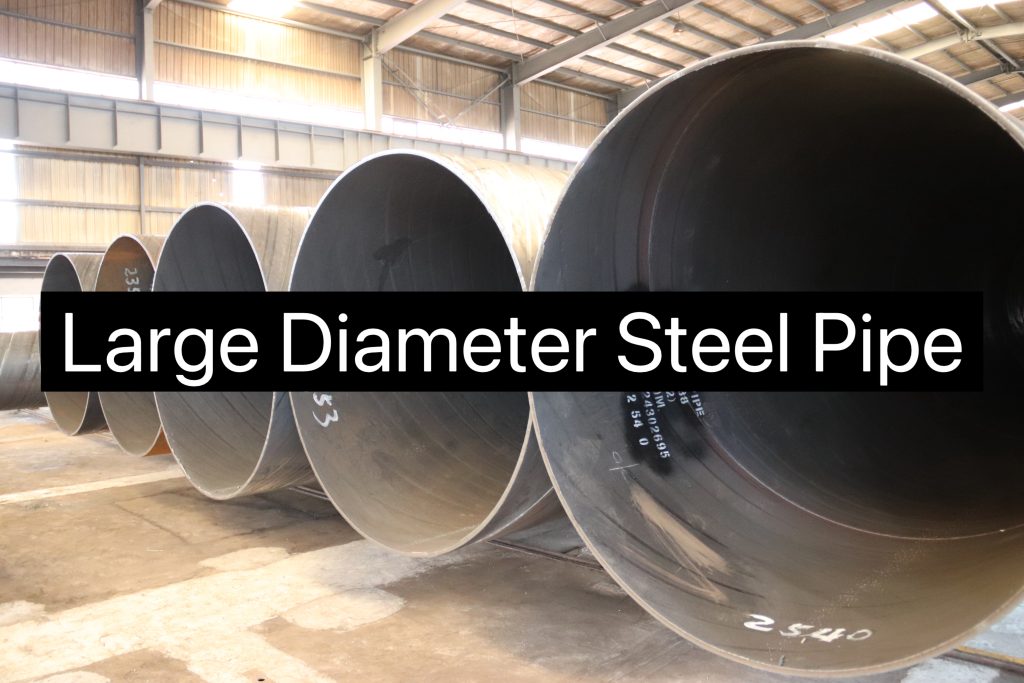
Large-diameter steel pipes are an important pillar of modern infrastructure design and play a very important role in industrial applications, especially transportation and water conservancy. This article will introduce large-diameter pipes from multiple aspects such as definition, standards, and application scenarios, so that you can have a clear and in-depth understanding of large-diameter steel pipes.
Large Diameter Steel Pipe
Define of large diameter steel pipe?
Large diameter steel pipe can be categorized as standard large diameter, extra large diameter, and super large diameter. The definition of large diameter varies significantly across industries, and your factory’s specific piping standards should be considered. However, generally, any pipe with a diameter exceeding 450 mm is considered large diameter steel pipe.
- Standard large diameter: 406-1000 mm
- Extra large diameter: 1000-3000 mm
- Super large diameter: 3000 mm and above
Large diameter steel pipe manufacturing process
There are three main processes for producing large-diameter pipes:
ERW: Large-diameter pipes require more material and are more expensive, making ERW more cost-effective than other processes. Its core process utilizes high-frequency resistance welding, which provides greater dimensional accuracy and uniform wall thickness. This process is suitable for producing pipes with diameters less than 24 inches.
SSAW: This process utilizes spiral forming and internal and external spiral submerged arc welding. It is suitable for producing pipes with diameters of 406-3048 mm. The same steel strip can be used to produce pipes of varying diameters, but dimensional accuracy is lower and welds are longer.
LSAW: This process utilizes JCOE or UOE forming technology and is suitable for producing very large pipes with diameters of 914-5182 mm. LASW-produced pipes are resistant to high temperatures and pressures, and exhibit uniform stress distribution.
Size range of different standards
For some international standard Large diameter steel pipe , the common diameter range and wall thickness range are as follows:
| Applicable standards | API 5L Gr.B | ASTM A53 | ASME B36.10M |
| Diameter range | 16″-24″ | 24″-48″ | 48″-120″ |
| Common wall thickness | 6.35-25.4mm | 9.53-38.1mm | 12.7-50.8mm |
Application of large diameter steel pipe
Bored shaft casing
The American Society of Civil Engineers (ASCE) stated in the Standard Guide for Pile Foundation Design and Installation that bored piles without casings have a 38% lower bearing capacity safety factor, so using only large-diameter steel pipes as bored shaft casings can improve construction efficiency.
Structural part
Large diameter steel pipe show excellent anti-buckling performance when subjected to external pressure. This makes large-diameter steel pipes widely used in bridges, buildings, high-rise structures and other heavy projects.
Caisson
The caisson is an infrastructure component widely used in bridge engineering. It usually uses Large diameter steel pipe with a length of up to 10 feet. It is drilled into the riverbed to provide stable support.
Things to note before purchasing large diameter seamless pipes
First of all, seamless pipes cannot have welds, but some unscrupulous merchants will use imperceptible methods to eliminate welds, so be extra careful. Secondly, pay attention to the overall uniformity and roundness. Large-diameter seamless pipes have high strength. And when the pipe is filled with materials, it will also share some of the weight and can withstand greater pressure. It can work in extremely cold or extremely hot environments.


